

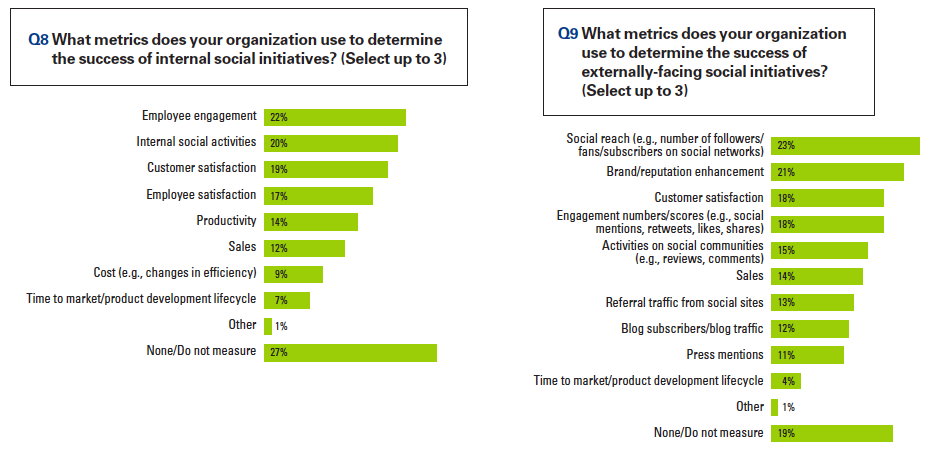
Social Business Metrics (inside and outside) according to MIT Sloan Management Review Report (July, 2013, p.22)
[…] “While the primary directive of the network is linking, paranodality is concerned—to paraphrase Lovink—with whatever the mirror phantom of linking is. A few examples of paranodalities might help to illustrate the concept: a close friend orfamily member who refuses to participate in the latest social media craze and remains a conspicuous hole in our social network is an example of a paranode; broken web links pointing to pages thatno longer exist or cached versions of pagesno longer active are paranodal because they represent phantom nodes; signal jammers
such as RFID (radio-frequency identification) blockers that prevent network devices from being found are examples of technologies that create paranodality; public spaces without surveillance cameras are paranodal spaces; radio operators without a license (pirate radio) are paranodal because they function without validation from the network; any kind of wilderness where signal reception cannot be established is paranodal; digital viruses and parasites that obstruct the operations of a network are also examples of paranodal technologies; obsolete technology is
paranodal because its usage is no longer required to operate the network; digital noise and glitches are paranodal because they interfere with the fow of data in the network; paranodality is a lost information packet on the Internet; populations in a dataset that are excluded or discriminated against by an algorithm become paranodal; punk or rogue nodes—nodes who belong to a network only in order to destroy it—are paranodal” (“Off the Network.Disrupting the Digital World”, Ulises Ali MejiAs, Minnesota University Press, 2013, p.154-155)

There Is No Content. Theories of media and culture continue to propagate an idea of something called “content.” But the notion that content may be separated from the technological vehicles of representation and conveyance that supposedly facilitate it is misguided. Data has no technique for creating meaning, only techniques for interfacing and parsing. To the extent that meaning exists in digital media, it only ever exists as the threshold of mixtures between two or more technologies. Meaning is a data conversion. What is called “Web content” is, in actual reality, the point where standard character sets rub up against the hypertext transfer protocol. There is no content; there is only data and other data. In Lisp there are only lists; the lists contain atoms, which themselves are other lists. To claim otherwise is a strange sort of cultural nostalgia, a religion. Content, then, is to be understood as a relationship that exists between specific technologies. Content, if it exists, happens when this relationship is solidified, made predictable, institutionalized, and mobilized” (Galloway and Thacker, The Exploit. A theory of network”

[…] To sum up, and provide a tentative and sufficiently broad definition, a game metric is a quantitative measure of one or more attributes of one or more objects that operate in the context of games. Translated into plain language, this definition clari-fies that a game metric is a quantitative measure of something related to games.
An object can in this case be anything operating in the context – a virtual item, code, a player, a process, a person, forum post, etc. etc. With context is meant that the metric has to be tied directly to the design of one or more games, the process of de-veloping, supporting and maintaining it, technical performance of the infrastructure, quality assurance, the business aspects that tie directly into the game (e.g. number of virtual items sold), the behavior of the users, etc. All of these form the game context. To clarify with a few examples: a measure of how many daily active users a social online game has; a measure of how many units a game has sold last week; how many times players completed level seven; task completion rates in a production team for a specific title, etc. – are all game metrics, because they relate directly to the process, performance or users in relation to one or more games.
Conversely, metrics that are unrelated to the games context, for example the revenue of a game development company last year, the number of employee complaints last month, etc., are business metrics. The distinction can be blurry in practice, but is essential to separate what is purely business metrics with those metrics that relate to the games themselves, of which a number are unique to game development compared to the remainder of the IT industry (in how many other IT sectors can “number of orcs killed per player” be a business-relevant metric?).
Chapter 2: Game Analytics – The Basics (Anders Drachen, Magy Seif El-Nasr1, Alessandro Canossa)

[…] Computers have conflated memory with storage, the ephemeral with the enduring. Rather than storing memories, we now put things “ into memory, ” both consciously and unconsciously. “ Memory ” — computer memory — has become surprisingly permanent. As Matthew Kirschenbaum has argued, our digital traces remain far longer than we suppose. Hard drives fail, but can still be “ read ” by forensic experts (optically, if not mechanically); our ephemeral documents and other “ ambient data ” are written elsewhere — that is “ saved ” — constantly. Again, to read information is to write it elsewhere. At the same time, however, the enduring is also the ephemeral. Not only because even if data storage devices can be read forensically after they fail they still eventually fail, but also because — and more crucially — what is not constantly upgraded or “ migrated ” or both becomes unreadable. As well, our interactions with computers cannot be reduced to the traces we leave behind. The experiences of using — the exact paths of execution — are ephemeral. Information is “ undead ” : neither alive nor dead, neither quite present nor absent” (Programmed Visions: Software and Memory, by Wendy Hui Kyong Chun, The MIT Press, 2011)

[abstract] In this position paper we argue that certain types of social media systems, such as Instagram and Foursquare, can act as valuable source of sensing, providing access to important characteristics of urban locations and urban social behavior. We discuss some of our previous studies and present our thoughts about the future of this eld based insights obtained from them.
Click to access silva_sencity13.pdf

[…] “The primary goal of the model of digital media developed above is not found in its individual components. My main hope is not that readers will come away with an understanding of every nuance of what I mean by data or surface. Rather, my hope is that a basic understanding of these components will provide the foundation for a new approach to thinking about digital media (and computational systems more generally). I use the term operational logics, described further below, to name a new type of thinking can help identify and analyze. When a work of digital media operates, this can be seen as an interplay between the elements of the model discussed so far: data, process, surface, interaction, interplay can be informative. Is the system actually doing what it is described as doing? What unspoken assumptions are built into the ways in which operations proceed?” (Noah Wardrip-Fruing, Expressive Processing. Digital Fictions, Computer Games and Software Studies, The MIT Press)

[…] What can be learned from software? The introduction of this book suggest that making an ontology of software would could heighten sensitivities to one contemporary site of mutability, contingency and necessity. It argued that software is a symptomatic present-day object that leads a complicated, circulatory existence. Software is a neighborhood of relations whose contours trace contemporary production, communication and consumption. Code is a multivalent index of the relation running among different classes of entity: originators, prototypes and recipients. These classes might include people, situations, organizations, places, devices, habits and practices. In code and coding, relations are assembled, dismantled, bundled and dispersed within and across contexts. Such relations are inextricable from agential effects, from some asymmetry between doing and being done. Indeed. agency is nothing without relations (A. Mackenzie, Cutting Code. Software and Sociality, p.169)

 cosimoaccoto.com