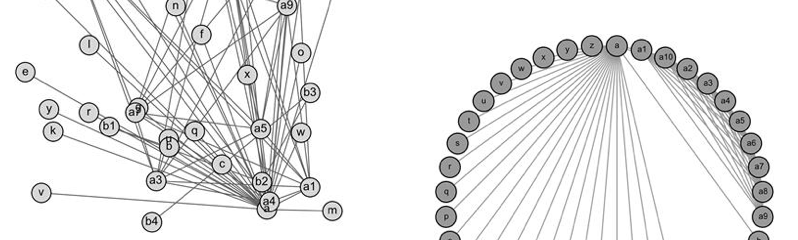
databases have recapitulated social and organizational developments #bigdata

Schermata 05-2456432 alle 16.53.58

“Database development has followed this vein. The early databases were hierarchical – you needed to go down a detailed line of authority each time you wanted to retrieve a datum. Then we had relational databases, where there was still central control but much more flexible access (the database system, like society at the time, was seen as a fixed structure). Today we have moved into a world of object-oriented and object-relational databases, in which each data object lives in a Tardean paradise — any structure can be evanescent providing we know the inputs or outputs of any object within it. So databases have recapitulated social and organizational developments. And many organizations changed in the 1990s and 2000s in an effort to become more “ object-oriented ” ; forgetting that the first object-oriented language (Simula, a precursor to Smalltalk) attempted to model work practice. Along the way, we have conceived ourselves and the natural entities in terms of data and information. We have flattened both the social and the natural into a single world so that there are no human actors and natural entities but only agents (speaking computationally) or actants (speaking semiotically) that share precisely the same features. It makes no sense in the dataverse to speak of the raw and the natural or the cooked and the social: to get into it you already need to be defined as a particular kind of monad” (“Data Flakes”, Geoffrey C. Bowker, in “Raw Data is an Oxymoron”, 2013, The MIT Press, p. 169)

Governing Algorithms: A Provocation Piece (2013) #bigdata

“This provocation piece addresses the recent rise of algorithms as an object of interest in research, policy, and practice. It does so through a series of provocations that aim to trouble the coherence of the algorithm as an analytic category and to challenge some of the assumptions that characterize current debates. The goal of this piece is thus to stimulate discussion and provide a critical backdrop against which the Governing Algorithms conference can unfold. It asks whether and how we can turn the “problem of algorithms” into an object of productive inquiry” (Barocas et alii, 2013).

http://papers.ssrn.com/sol3/papers.cfm?abstract_id=2245322Schermata 05-2456431 alle 08.52.14


Social Science in the Era of #BigData (by Gonzalez-Bailon, pdf)

Schermata 05-2456428 alle 23.11.05


Abstract: 
Digital technologies keep track of everything we do and say while we are online, and we spend online an increasing portion of our time. Databases hidden behind web services and applications are constantly fed with information of our movements and communication patterns, and a significant dimension of our lives, quantified to unprecedented levels, gets stored in those vast online repositories. This article considers some of the implications of this torrent of data for social science research, and for the types of questions we can ask of the world we inhabit. The goal of the article is twofold: to explain why, in spite of all the data, theory still matters to build credible stories of what the data reveal; and to show how this allows social scientists to revisit old questions at the intersection of new technologies and disciplinary approaches. The article also considers how Big Data research can transform policy making, with a focus on how it can help us improve communication and governance in policy-relevant domains (Gonzalez-Bailon, 2013)

https://papers.ssrn.com/sol3/papers.cfm?abstract_id=2238198

Algorithms as Institutions #bigdata

[ from the introduction] “Algorithms are widely recognized as playing an increasingly influential role in the political, economic, and cultural spheres (Mayer-Schonberger, & Cukier, 2013; Pariser, 2011; Steiner, 2012). Algorithms are serving particularly prominent roles in the media sector, where the processes of media production, consumption, and even advertising placement, are increasingly automated and algorithmically dictated (see, e.g., Danaher, Lee, & Laoucine, 2010; Mager, 2012; Steiner, 2012). Clearly, then, the algorithmic turn (to borrow Uricchio’s [2011] phrase) that is taking place in the media sector should be a focal point for communication and media studies scholarship. Researchers have begun to examine this transition in a number of contexts and from a variety of analytical perspectives (see, e.g., Beer, 2001; Gillespie, 2011; Webster, 2011). But, as is to be expected in these early stages of an emergent area of inquiry, there has been relatively little discussion of useful theoretical frameworks (for exceptions, see Anderson, in press; Webster, 2011). This paper attempts to address this gap via an exploration of how institutional theory can inform and guide future research on the algorithmic turn in media production and consumption, as well as provide a lens through which to interpret extant research in this area” (Philip M. Napoli, May 2013)

Napoli, Philip M., The Algorithm as Institution: Toward a Theoretical Framework for Automated Media Production and Consumption (May 5, 2013).

http://papers.ssrn.com/sol3/papers.cfm?abstract_id=2260923

Schermata 05-2456424 alle 19.10.38)

Digital Patient Experience Economy and #Bigdata

[Abstract] “As part of the digital health phenomenon, a plethora of interactive digital platforms have been established in recent years to elicit lay people’s experiences of illness and healthcare. The function of these platforms, as expressed on the main pages of their websites, is to provide the tools and forums whereby patients and caregivers, and in cases medical practitioners, can share their experiences with others, benefit from the support and knowledge of other contributors and contribute to large aggregated data archives as part of developing better medical treatments and services and conducting medical research. However what may not always be readily apparent to the users of these platforms are the growing commercial uses by many of the platforms’ owners of the archives of the data they contribute. This article examines this phenomenon of what I term ‘the digital patient experience economy’. In so doing I discuss such aspects as prosumption, the phenomena of big data and metric assemblages, the discourse and ethic of sharing and the commercialisation of affective labour via such platforms. I argue that via these online platforms patients’ opinions and experiences may be expressed in more diverse and accessible forums than ever before, but simultaneously they have become exploited in novel ways” (Debora Lupton, 2013)

Deborah Lupton (2013) The Commodification of Patient Opinion: the Digital Patient Experience Economy in the Age of Big Data. Sydney Health & Society Group Working Paper No. 3. Sydney: Sydney Health & Society Group. Schermata 05-2456424 alle 14.11.47


reading “Raw Data is an Oxymoron” (ed. Gitelman, 2013) #Bigdata

“Like events imagined and enunciated against the continuity of time, data are imagined and enunciated against the seamlessness of phenomena. We call them up out of an otherwise undifferentiated blur. If events garner a kind of immanence by dint of their collected enunciation, as Hayden White has suggested, so data garner immanence in the circumstances of their imagination. Events produce and are produced by a sense of history, while data produce and are produced by the operations of knowledge production more broadly. Every discipline and disciplinary institution has its own norms and standards for the imagination of data, just as every field has its accepted methodologies and its evolved structures of practice. Together the essays that comprise “ Raw Data ” Is an Oxymoron pursue the imagination of data. They ask how different disciplines have imagined their objects and how different data sets harbor the interpretive structures of their own imagining. What are the histories of data within and across disciplines? How are data variously “ cooked ” within the varied circumstances of their collection, storage, and transmission? What sorts of conflicts have occurred about the kinds of phenomena that can effectively — can ethically — be “ reduced ” to data?” (ed. Lisa Gitelman, 2013, “Raw Data is an Oximoron”, The MIT Press, p. 3)

Schermata 05-2456423 alle 19.47.55

The data directive. How data is driving corporate strategy—and what still lies ahead #bigdata

“The data directive is an Economist Intelligence Unit (EIU) report, commissioned by Wipro. It seeks to explore the degree to which the ongoing data revolution within business is delivering truly strategic change within companies, as opposed to more incremental optimisation gains. Although many of the issues discussed here stray into the realm of so-called “big data”, this report is not explicitly focussed on that topic and does not deal with any technology-related issues. Instead, it seeks to explore how the wider trend toward a greater reliance on data is affecting the strategic management of businesses at a C-suite level, across a range of industries” (The Economist – Intelligence Unit, April 2013)

Click to access Data_directive_main_Apr25_web_FINAL2.pdf

Schermata 05-2456422 alle 20.44.51

Big Data Analytics (by Arvind Sathi, 2013)

Schermata 05-2456419 alle 20.19.37

“So, what is Big Data? There are two common sources of data grouped under the banner of Big Data. First, we have a fair amount of data within the corporation that, thanks to automation and access, is increasingly shared. This includes emails, mainframe logs, blogs, Adobe PDF documents, business process events, and any other structured, unstructured, or semi-structured data available inside the organization. Second, we are seeing a lot more data outside the organization some available publicly free of cost, some based on paid subscription, and the rest available selectively for specific business partners or customers. This includes information available on social media sites, product literature freely distributed by competitors, corporate customers’ organization hierarchies, helpful hints available from third parties, and customer complaints posted on regulatory sites” (from “Big Data Analytics”, Arvind Sathi, 2013)