
I’m really pleased and honored to have been given the opportunity to write the afterword of “Fisica sociale” (UBE 2015), the italian version of “Social Physics” by Alex Pentland, edited by UBE Bocconi University Press.

I’m really pleased and honored to have been given the opportunity to write the afterword of “Fisica sociale” (UBE 2015), the italian version of “Social Physics” by Alex Pentland, edited by UBE Bocconi University Press.
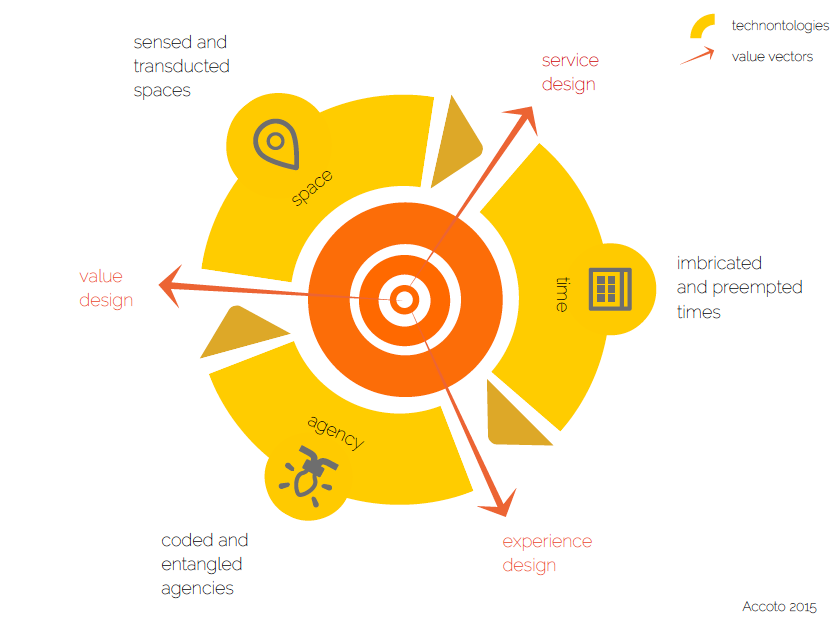
My sketch for a value redesign model. Time, space and agency mapped for experience, service and value design.

Introduzione –
È tempo di muovere le riflessioni tecnologiche e di business contemporanee verso una nuova prospettiva ontologica o, per usare un neologismo, tecnontologica. Impiegherò, in questo percorso, il termine “realismo digitale” per indicare questo programma di ricerca […]
Questo nuovo realismo digitale non descrive un processo di “simulazione” del reale, ma bensì un processo di “attuazione” del reale. Non di “emulazione” del reale si tratta, ma –come ha di recente annunciato William Gibson– di “eversione” del reale. L’idea di questo programma di ricerca matura nella consapevolezza che il “reale” che sperimentiamo, oggi, sia indissolubilmente permeato di “digitalità”. Parlare, oggi, di “realtà” senza esplicitare le forme molteplici della digitalità sociale generativa che vi è incorporata (computazione e codice software, algoritmi e intelligenza artificiale, database e reti informazionali, sensori e attuatori) è, sempre più, privo di senso […]
In questo orizzonte, dopo un’introduzione di inquadramento, affronterò questa attuazione digitale del reale in tre fondamentali linee vettoriali di sviluppo: a) la transduzione dello spazio; b) l’imbricazione del tempo; c) la codificazione del soggetto. In questa sequenza, analizzerò i nuovi rapporti genetici tra codice software e spazio, i regimi temporali nuovi che emergono dalla digitalità; le agentività di matrice algoritmica, umane e macchiniche, oggi in azione (continua…)

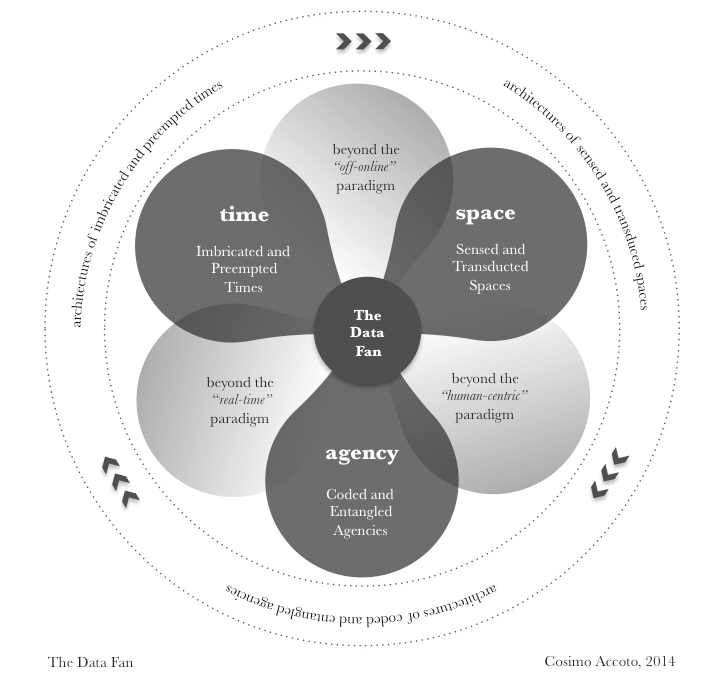
Forget the Big Data 3V’s. Tuning my framework grounded on: 1) time, 2) space and 3) agency. I started to call it “digital realism” to stress the process of digital eversion of the real. I think it’s time to go beyond the current trivial big data and digital transformation discourse and to focus on 3 foundational dimensions: 1) imbricated and preempted time, 2) sensed and transducted space and 3) coded and entangled agency and to stress 3 business vectors grounded on this technontological architecture: a) value design; b) service design and c) experience design (Accoto 2105)

Il video del mio keynote a Better Decisions Forum 2014
(my keynote video at Better Decisions Forum 2014)


“Data is our ultimate world interface”
| Accoto 2014 |
“In digital realism, a data-driven service instantiation is vectorialized by pre/mediation, im/mediacy, sub/mediality”
| Accoto 2014 |
“In digital realism, data agency is ontologically: 1) imbricated 2) entangled 3) coded 4) premediated”
| Accoto 2014 |
“Big Data is not about 3V’s (and its variants). It’s about space, time and agency: an ontology shift rather than a technology”
| Accoto 2014 |
“In a digital realism perspective, body and code tend to coincide. In the biotic interrupt, the act is indistinguishable from the abstr/act”
| Accoto 2014 |
“Premediative or anticipatory regimes instantiate and operationalize customer data enacting customer horizons”
| Accoto 2014 |
“Quantified Self is not just about lifelogging, but it’s more about lifehacking. Self-hacking is a new self-governing practice”
| Accoto 2014 |
“To be mediated by the immediacy, with N=all (totality) and T=-1 (premediation), is the service instantiation in a data-intensive age”
| Accoto 2014 |
“Quantified selves (Ostherr 2013), social machines (Semmelhack 2013), ambient commons (McCullough 2013) are data actants”
| Accoto 2014 |
“Data Ontologies: Totality, Immediacy, Premediation are the ontological vectors reshaping businesses and organizations”
| Accoto 2014 |
“In a data deictic perspective, a quantified, networked and anticipated self is emerging as new marketing platform”
| Accoto 2014 |
“Data deixis changes the logic of the customer segmentation. It’s no longer a logic of set, rather a logic of emergence”
| Accoto 2014 |
“In data-intensive age, customer centricity is useless unless you include the algorithmic mediation of secondary agency”
| Accoto 2014 |
“The ‘data continuum’ paradigm is reshaping customer information markets and systems as well as industry boundaries”
| Accoto 2014 |
“Looking at data as new personal and partecipatory markets devices is a way to deeply understand our data-intensive age”
| Accoto 2014 |
“In a data-intensive age, “real-time” is an ontological continuum spanning from subperceptuality to embedded temporalities”
| Accoto 2014 |
“Market, marketing or marke-things intelligence? In an ubiquitous data age, the situated analytics performs operations
| Accoto 2014 |
“Technologies for markets remote sensing are not monitoring practices, but modeling devices for new value propositions”
| Accoto 2014 |
“Big Data is about Transduction of Coded Spaces, Subperceptuality of Emebedded Temporalities and Machinic Secondary Agencies”
| Accoto 2014 |
“In a subperceptual regime of temporality, the im-mediate is ontologically and conceptually linked to the un-mediated”
| Accoto 2014 |
“In digital age, we have performances not contents, performers not users, performables not channels”
| Accoto 2014 |
“In a data-intensive age, customer centricity is useless unless you include the algorithmic mediation of secondary agency”
| Accoto 2014 |

“In digital realism, a data-driven service instantiation is vectorialized by pre/mediation, im/mediacy, sub/mediality”
| Accoto 2014 |
“In digital realism, data agency is ontologically: 1) imbricated 2) entangled 3) coded 4) premediated”
| Accoto 2014 |
“Big Data is not about 3V’s (and its variants). It’s about space, time and agency: an ontology shift rather than a technology”
| Accoto 2014 |
“In a digital realism perspective, body and code tend to coincide. In the biotic interrupt, the act is indistinguishable from the abstr/act”
| Accoto 2014 |
“Premediative or anticipatory regimes instantiate and operationalize customer data enacting customer horizons”
| Accoto 2014 |
“Quantified Self is not just about lifelogging, but it’s more about lifehacking. Self-hacking is a new self-governing practice”
| Accoto 2014 |
“To be mediated by the immediacy, with N=all (totality) and T=-1 (premediation), is the service instantiation in a data-intensive age”
| Accoto 2014 |
“Quantified selves (Ostherr 2013), social machines (Semmelhack 2013), ambient commons (McCullough 2013) are data actants”
| Accoto 2014 |
“Data Ontologies: Totality, Immediacy, Premediation are the ontological vectors reshaping businesses and organizations”
| Accoto 2014 |
“In a data deictic perspective, a quantified, networked and anticipated self is emerging as new marketing platform”
| Accoto 2014 |
“Data deixis changes the logic of the customer segmentation. It’s no longer a logic of set, rather a logic of emergence”
| Accoto 2014 |
“In data-intensive age, customer centricity is useless unless you include the algorithmic mediation of secondary agency”
| Accoto 2014 |
“The ‘data continuum’ paradigm is reshaping customer information markets and systems as well as industry boundaries”
| Accoto 2014 |
“Looking at data as new personal and partecipatory markets devices is a way to deeply understand our data-intensive age”
| Accoto 2014 |
“In a data-intensive age, “real-time” is an ontological continuum spanning from subperceptuality to embedded temporalities”
| Accoto 2014 |
“Market, marketing or marke-things intelligence? In an ubiquitous data age, the situated analytics performs operations
| Accoto 2014 |
“Technologies for markets remote sensing are not monitoring practices, but modeling devices for new value propositions”
| Accoto 2014 |
“Big Data is about Transduction of Coded Spaces, Subperceptuality of Emebedded Temporalities and Machinic Secondary Agencies”
| Accoto 2014 |
“In a subperceptual regime of temporality, the im-mediate is ontologically and conceptually linked to the un-mediated”
| Accoto 2014 |
“In digital age, we have performances not contents, performers not users, performables not channels”
| Accoto 2014 |
“In a data-intensive age, customer centricity is useless unless you include the algorithmic mediation of secondary agency”
| Accoto 2014 |

 cosimoaccoto.com