“The Whole is Always Smaller Than Its Parts” … Latour and #bigdata

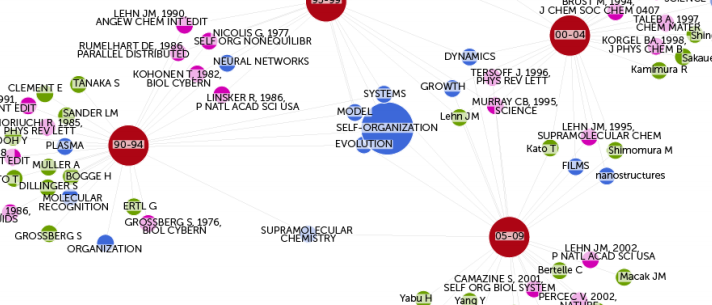
Abstract: “In this paper we argue that the new availability of digital data sets allows one to revisit Gabriel Tarde’s (1843-1904) social theory that entirely dispensed with using notions such as individual or society. Our argument is that when it was impossible, cumbersome or simply slow to assemble and to navigate through the masses of information on particular items, it made sense to treat data about social connections by defining two levels: one for the element, the other for the aggregates. But once we have the experience of following individuals through their connections (which is often the case with profiles) it might be more rewarding to begin navigating datasets without making the distinction between the level of individual component and that of aggregated structure. It becomes possible to give some credibility to Tarde’s strange notion of ‘monads’. We claim that it is just this sort of navigational practice that is now made possible by digitally available databases and that such a practice could modify social theory if we could visualize this new type of exploration in a coherent way”

Click to access Latour_et_al-The_Whole_is_Less.pdf
Schermata 06-2456463 alle 22.29.59

… concerning the undecidability of the digital image #bigdata

[Abstract] “In this paper we consider the significance of metadata in relation to image economy of the  web. Social practices such as keywording, tagging, rating and viewing increasingly influence  the modes of navigation and hence the utility of images in online environments. To a user  faced with an avalanche of images, metadata promises to make photographs machine readable in order to mobilize new knowledge, in a continuation of the archival paradigm. At  the same time, metadata enables new topologies of the image, new temporalities and multiplicities which present a challenge to historical models of representation. As photography becomes an encoded discourse, we suggest that the turning away from the  visual towards the mathematical and the algorithmic establishes undecidability as a key property of the networked image” (Notes on the Margins of Metadata: concerning the undecidability of the digital image, Daniel Rubinstein and Katrina Sluis, 2013)

Click to access DR_KS_Notes-on-the-Margins-of-Metadata.pdf

Schermata 06-2456461 alle 20.23.11

“Social Business Intelligence: a Literature Review and Research Agenda” #bigdata

[from the abstract] “The domains of Business Intelligence (BI) and social media have meanwhile become significant research fields. While BI aims at supporting an organization’s decisions by providing relevant analytical data, social media is an emerging source of personal and individual knowledge, opinion, and attitudes of stakeholders. For a while, a convergence of the two domains can be observed in real-world implementations and research, resulting in concepts like social BI. Many research questions still remain open – or even worse – are not yet formulated. Therefore, the paper aims at articulating a research agenda for social BI. By means of a literature review we systematically explored previous work and developed a framework. It contrasts social media characteristics with BI design areas and is used to derive the social BI research agenda. Our results show that the integration of social media (data) into a BI system has impact on almost all BI design objects” (Barbara Dinter, Anja Lorenz, 2013)

http://www.qucosa.de/fileadmin/data/qucosa/documents/10587/Dinter_Lorenz_Social_Business.pdfSchermata 06-2456461 alle 14.31.02

“Again, to read information is to write it elsewhere” #bigdata

“Computers have conflated memory with storage, the ephemeral with the enduring. Rather than storing memories, we now put things “ into memory, ” both consciously and unconsciously. “ Memory ” — computer memory — has become surprisingly permanent. As Matthew Kirschenbaum has argued, our digital traces remain far longer than we suppose. Hard drives fail, but can still be “ read ” by forensic experts (optically, if not mechanically); our ephemeral documents and other “ ambient data ” are written elsewhere — that is “ saved ” — constantly. Again, to read information is to write it elsewhere. At the same time, however, the enduring is also the ephemeral. Not only because even if data storage devices can be read forensically after they fail they still eventually fail, but also because — and more crucially — what is not constantly upgraded or “ migrated ” or both becomes unreadable. As well, our interactions with computers cannot be reduced to the traces we leave behind. The experiences of using — the exact paths of execution — are ephemeral. Information is “ undead ” : neither alive nor dead, neither quite present nor absent” (“Programmed Visions. Software and Memory”, Wendy Hui Kyong Chun, The MIT Press, 2011, 133)

Schermata 06-2456460 alle 15.51.44

“That visceral act is actually an interaction: you have just participated in a data-mining operation” #bigdata

“You see it everywhere today. The telltale sign is the positive feedback loop. For example, you buy things with your credit card, presumably to satisfy needs or desires in your life. Needs, desires: you purchase at your soft points. That visceral act is actually an interaction: you have just participated in a data-mining operation. Your input feeds a marketing analysis apparatus, and that feeds a product development machine. The system eventually gets back to you with new products responding to the input, and with new ways to reach you, massage your rhythms, air out your viscera, induce you to spend. New needs and desires are created. Even whole new modes of experience, which your life begins to revolve around. You have become, you have changed, in interaction with the system. You have literally shopped yourself into being. At the same time, the system has adapted itself . It ’ s a kind of double capture of mutual responsiveness in a reciprocal becoming (Massumi, Semblance and Event, 2013, The MIT Press, 48)

Schermata 06-2456460 alle 13.10.51

“Interface Criticism. Aesthetics Beyond Buttons” (2012)

“Our conception of the interface is not restricted to the well-known  graphical user interface between humans and computers, e.g. the WIMP (Windows, Icons, Menus, Pointers) interfaces that have become popular and standardised on personal computers the last twenty-five years. As described by Florian Cramer in this volume, the term interface indicates many different contact points and exchanges between different programs and data layers in a computer,  between different machines (e.g. in a network), between humans and machines (such as graphical user interfaces), and as a mediator between humans (e.g. in net culture, interface culture and the public sphere). Some interfaces seem more or less mechanical – such  as the USB interface that most of us know as a plug, but which is in fact an interface that specifies how communication between devices is established – while others are more clearly directed towards human understanding and cultural traditions such as interfaces for computer games or digital art. All interfaces, however, are designs that combine – and translate – signs and signals”

Schermata 06-2456459 alle 21.54.49

Interface CriticismAesthetics Beyond Buttons (edited by Christian Ulrik Andersen & Søren Bro Pold)
Sample | http://samples.pubhub.dk/9788771242393.pdf

“This new mode of observation is pattern recognition” #bigdata

” […] Instead, the collection and collation of factors external to the subject enables the production of various combinations that form sets of different profiles, with each profile essentially being a specific combination of factors. At the moment databases ‘find’ or produce such a specific combination of factors, a subject is placed into the profile that fits that combination. This new mode of observation, in other words, is pattern recognition […] (Savat, Uncoding the Digital, 2013)

Schermata 06-2456453 alle 13.02.28

“That visceral act is actually an interaction: you have just participated in a data-mining operation” #bigdata

“…You see it everywhere today. The telltale sign is the positive feedback loop. For example, you buy things with your credit card, presumably to satisfy needs or desires in your life. Needs, desires: you purchase at your soft points. That visceral act is actually an interaction: you have just participated in a data-mining operation. Your input feeds a marketing analysis apparatus, and that feeds a product development machine. The system eventually gets back to you with new products responding to the input, and with new ways to reach you, massage your rhythms, air out your viscera, induce you to spend. New needs and desires are created. Even whole new modes of experience, which your life begins to revolve around. You have become, you have changed, in interaction with the system. You have literally shopped yourself into being. At the same time, the system has adapted itself . It ’ s a kind of double capture of mutual responsiveness in a reciprocal becoming” (Brian Massumi, Semblance and Event, MIT Press, 2013:48)

Schermata 06-2456446 alle 22.08.32

“Data mining is essentially a plastic art” #bigdata

“With the postfordist colonization of affect and the concomitant valorization of affective difference, a body has no choice but to speak. A body speaks whether it wants to or not. This is the genius of the ” page rank” algorithm used by search engines: use graph theory to valorize pure heterogeneity, show how quality is an emergent property of quantity, as Barbara Cassin has written in her book on Google. Data mining is often considered in terms of location and extraction of nuggets of information from a sea of background noise. But this metaphor is entirely wrong. Data mining is essentially a plastic art, for it responds to the sculpture of the medium itself, to the background noise itself. I t valorize s the pure shape of relationships. Not “can” but “does” the body speak ? Yes, it has no choice. Making a phone call from the slums of Cairo or Mumbai or Paris , the subaltern “speaks ” into a database – just as much as I do when I pick up the pho ne . The difference for difference is no longer actual, it is technical. The subaltern speaks, and somewhere an algorithm listens” (A. Galloway, “The Interface Effect”, 2013)

Schermata 06-2456446 alle 20.04.41