“Welcome to the engine rooms of the Internet. Filled with rows of sophisticated computing equipment, massive air conditioners and elaborate electrical systems, Data Centers power the Internet, foster productivity, and drive the global economy. They’re also flat out cool—ultramodern technology chambers with peta-flops of processing and megawatts of electrical capacity. I began working in Data Centers more than 15 years ago, first stocking supplies and inventorying hardware, and eventually designing and managing dozens of these specialized computing environments for Cisco. I also visited hundreds of other Data Centers during those years, taking tours and chatting with their designers and managers whenever possible. Data Center folks are all trying to wrestle the same set of physics to the ground, and I’m always curious to see what elegant (or maybe not so elegant) solutions people have implemented. The idea for The Art of the Data Center originated in 2009 while I was working on a different book, Grow a Greener Data Center . I was writing about geothermal cooling and wanted to provide examples of Data Centers constructed underground and discovered Bahnhof’s co-location facility in Stockholm. Housed in a former nuclear bunker, it was dubbed “The James Bond Villain Data Center” by several technology websites thanks to unique features such as man-made waterfalls and a glass-walled conference room that looms over its data hall. I smiled at the cinematic touches such as dramatic lighting and artificial fog and wished I knew more about it” (from the Preface, The Art of Data Center, 2013)

Author: Cosimo Accoto
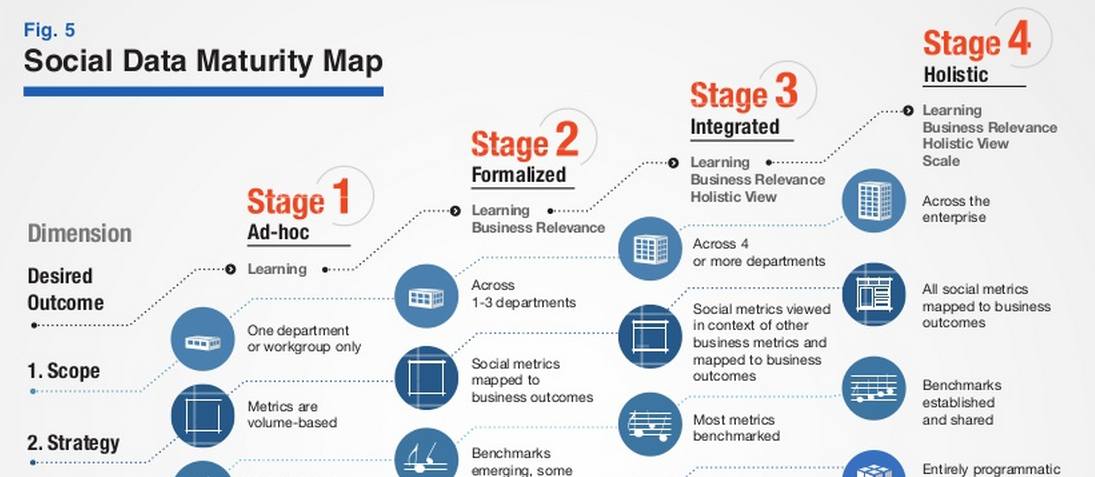
Social Data Maturity by Altimeter #socialdata #bigdata #socialintelligence #sbi
“According to Altimeter Group research, the average enterprise-class company owns 178 social media accounts, while 13 departments—from marketing to customer support to legal– actively engage in social media. Yet social media— and as a result, social data— are still largely isolated from business-critical enterprise data sourced from platforms such as Customer Relationship Management, Business Intelligence and market research. This lack of a holistic view of social signals in the context of other enterprise and external data can lead to partially-informed decisions, missed opportunity, and increased risk and cost, as the organization makes decisions without the benefit of critical input from external constituencies. In this Altimeter Group research report reflecting input from 35 enterprise-class organizations and technology ecosystem contributors, industry analyst Susan Etlinger lays out an imperative for Social Data Intelligence, identifying key dimensions that organizations must understand, pragmatic steps they can take toward mature integration, and how successful businesses are already using social data in the context of other critical enterprise data to drive measurable value throughout the organization (Altimeter Grouo, July 25 2013)
Social Employee #roi #socbiz #socialbusiness #analytics #sbi #bigdata
” […] It’s important to note here, however, that even though brands are finding proven ways to measure the ROI of social endeavors, it is generally agreed that ROI, in some ways, is beside the point. When talking about social business, the discussion refers to building a culture of empowered, engaged social employees who are as confident working collaboratively as they are working independently. Social business, then, is a long-term game plan for corporate sustainability, accountability, and transparency. The benefits of social business grow exponentially—and will continue to be felt for generations to come. Thinking simply in terms of ROI is, quite frankly, far too narrow a view when experiencing nothing short of a cultural revolution […] “from the Social Employee, 2013” (Burgess and Burgess, “The Social Employee”, 2013, p.30)
Databases and Time #bigdata #socialdata #
“I understand the temporality of database aesthetics as a system that may re-present the past, a system that may make the past present again. But not in the sense that is merely reconfigured by a technological process. Here I do not picture the past as an outside to be grasped by the database and organized. Rather I view the database as a process. Importantly, this is a process that not only changes the information that it archives but is also generative of a particular type of presentness in which the information is accessed. This is a process that brings pastness and presentness; a process that does not sit outside or beyond the everyday life, but rather a system that is involved in a process with everyday life; a system that is necessarily temporal” (p. 161-162) in Time and the Digital: Connecting Technology, Aesthetics and a Process Philosophy of Time, by Timothy Scott Barker; 2013, University Press of England)
See in particular, chapter 8 “DATABASES AND TIME”
• Multi-temporality and Frames
• Organizing Temporality
• Events and the Archive
• The Database in Time
• The Database and Temporal Relationships
• Reterritorializing Data
• Databases and the Extension of Occasions
social ties of employees and information flow in Yammer #bigdata #socialbiz #socialbusinessintelligence #analytics
[Abstract] As popular social media have been adopted by corporations for professional sharing and internal communication, ties are strengthened in the network as employee users communicate frequently with each other on work practices. On the other hand, the company hierarchy connects and governs users in a way that shapes the pattern of posting activity, interactions and enacted topics. In this paper, we investigate social ties of employees and information flow in Yammer communication by quantifying the effect of company hierarchy with experiments on a large-scale real dataset…”
http://www-scf.usc.edu/~ketansin/673/CSCI_673_Project_Paper.pdf
“They belong to a mechanogram of recursive diagramming” #datamining #bigdata #databases
Social Business Metrics (inside and outside) MIT Sloan Report #socbiz #socialbusinessintelligence #sbi
Paranodal and paranodality in network age #bigdata #networkpolitics #code
[…] “While the primary directive of the network is linking, paranodality is concerned—to paraphrase Lovink—with whatever the mirror phantom of linking is. A few examples of paranodalities might help to illustrate the concept: a close friend orfamily member who refuses to participate in the latest social media craze and remains a conspicuous hole in our social network is an example of a paranode; broken web links pointing to pages thatno longer exist or cached versions of pagesno longer active are paranodal because they represent phantom nodes; signal jammers
such as RFID (radio-frequency identification) blockers that prevent network devices from being found are examples of technologies that create paranodality; public spaces without surveillance cameras are paranodal spaces; radio operators without a license (pirate radio) are paranodal because they function without validation from the network; any kind of wilderness where signal reception cannot be established is paranodal; digital viruses and parasites that obstruct the operations of a network are also examples of paranodal technologies; obsolete technology is
paranodal because its usage is no longer required to operate the network; digital noise and glitches are paranodal because they interfere with the fow of data in the network; paranodality is a lost information packet on the Internet; populations in a dataset that are excluded or discriminated against by an algorithm become paranodal; punk or rogue nodes—nodes who belong to a network only in order to destroy it—are paranodal” (“Off the Network.Disrupting the Digital World”, Ulises Ali MejiAs, Minnesota University Press, 2013, p.154-155)
“There is no content; there is only data and other data..” #bigdata
There Is No Content. Theories of media and culture continue to propagate an idea of something called “content.” But the notion that content may be separated from the technological vehicles of representation and conveyance that supposedly facilitate it is misguided. Data has no technique for creating meaning, only techniques for interfacing and parsing. To the extent that meaning exists in digital media, it only ever exists as the threshold of mixtures between two or more technologies. Meaning is a data conversion. What is called “Web content” is, in actual reality, the point where standard character sets rub up against the hypertext transfer protocol. There is no content; there is only data and other data. In Lisp there are only lists; the lists contain atoms, which themselves are other lists. To claim otherwise is a strange sort of cultural nostalgia, a religion. Content, then, is to be understood as a relationship that exists between specific technologies. Content, if it exists, happens when this relationship is solidified, made predictable, institutionalized, and mobilized” (Galloway and Thacker, The Exploit. A theory of network”