
According to Bonenfant et alii (Big Data and Governance, 2013) “immediacy” and “totality” are the two “ideological” dimensions of the “big data” discorse. Collecting thoughts for my next sketch .. 😉

According to Bonenfant et alii (Big Data and Governance, 2013) “immediacy” and “totality” are the two “ideological” dimensions of the “big data” discorse. Collecting thoughts for my next sketch .. 😉
[ from the introduction] “Algorithms are widely recognized as playing an increasingly influential role in the political, economic, and cultural spheres (Mayer-Schonberger, & Cukier, 2013; Pariser, 2011; Steiner, 2012). Algorithms are serving particularly prominent roles in the media sector, where the processes of media production, consumption, and even advertising placement, are increasingly automated and algorithmically dictated (see, e.g., Danaher, Lee, & Laoucine, 2010; Mager, 2012; Steiner, 2012). Clearly, then, the algorithmic turn (to borrow Uricchio’s [2011] phrase) that is taking place in the media sector should be a focal point for communication and media studies scholarship. Researchers have begun to examine this transition in a number of contexts and from a variety of analytical perspectives (see, e.g., Beer, 2001; Gillespie, 2011; Webster, 2011). But, as is to be expected in these early stages of an emergent area of inquiry, there has been relatively little discussion of useful theoretical frameworks (for exceptions, see Anderson, in press; Webster, 2011). This paper attempts to address this gap via an exploration of how institutional theory can inform and guide future research on the algorithmic turn in media production and consumption, as well as provide a lens through which to interpret extant research in this area” (Philip M. Napoli, May 2013)
Napoli, Philip M., The Algorithm as Institution: Toward a Theoretical Framework for Automated Media Production and Consumption (May 5, 2013).
http://papers.ssrn.com/sol3/papers.cfm?abstract_id=2260923
 )
)
[Abstract] “As part of the digital health phenomenon, a plethora of interactive digital platforms have been established in recent years to elicit lay people’s experiences of illness and healthcare. The function of these platforms, as expressed on the main pages of their websites, is to provide the tools and forums whereby patients and caregivers, and in cases medical practitioners, can share their experiences with others, benefit from the support and knowledge of other contributors and contribute to large aggregated data archives as part of developing better medical treatments and services and conducting medical research. However what may not always be readily apparent to the users of these platforms are the growing commercial uses by many of the platforms’ owners of the archives of the data they contribute. This article examines this phenomenon of what I term ‘the digital patient experience economy’. In so doing I discuss such aspects as prosumption, the phenomena of big data and metric assemblages, the discourse and ethic of sharing and the commercialisation of affective labour via such platforms. I argue that via these online platforms patients’ opinions and experiences may be expressed in more diverse and accessible forums than ever before, but simultaneously they have become exploited in novel ways” (Debora Lupton, 2013)
Deborah Lupton (2013) The Commodification of Patient Opinion: the Digital Patient Experience Economy in the Age of Big Data. Sydney Health & Society Group Working Paper No. 3. Sydney: Sydney Health & Society Group. 
“Like events imagined and enunciated against the continuity of time, data are imagined and enunciated against the seamlessness of phenomena. We call them up out of an otherwise undifferentiated blur. If events garner a kind of immanence by dint of their collected enunciation, as Hayden White has suggested, so data garner immanence in the circumstances of their imagination. Events produce and are produced by a sense of history, while data produce and are produced by the operations of knowledge production more broadly. Every discipline and disciplinary institution has its own norms and standards for the imagination of data, just as every field has its accepted methodologies and its evolved structures of practice. Together the essays that comprise “ Raw Data ” Is an Oxymoron pursue the imagination of data. They ask how different disciplines have imagined their objects and how different data sets harbor the interpretive structures of their own imagining. What are the histories of data within and across disciplines? How are data variously “ cooked ” within the varied circumstances of their collection, storage, and transmission? What sorts of conflicts have occurred about the kinds of phenomena that can effectively — can ethically — be “ reduced ” to data?” (ed. Lisa Gitelman, 2013, “Raw Data is an Oximoron”, The MIT Press, p. 3)

“The data directive is an Economist Intelligence Unit (EIU) report, commissioned by Wipro. It seeks to explore the degree to which the ongoing data revolution within business is delivering truly strategic change within companies, as opposed to more incremental optimisation gains. Although many of the issues discussed here stray into the realm of so-called “big data”, this report is not explicitly focussed on that topic and does not deal with any technology-related issues. Instead, it seeks to explore how the wider trend toward a greater reliance on data is affecting the strategic management of businesses at a C-suite level, across a range of industries” (The Economist – Intelligence Unit, April 2013)
Click to access Data_directive_main_Apr25_web_FINAL2.pdf


“So, what is Big Data? There are two common sources of data grouped under the banner of Big Data. First, we have a fair amount of data within the corporation that, thanks to automation and access, is increasingly shared. This includes emails, mainframe logs, blogs, Adobe PDF documents, business process events, and any other structured, unstructured, or semi-structured data available inside the organization. Second, we are seeing a lot more data outside the organization some available publicly free of cost, some based on paid subscription, and the rest available selectively for specific business partners or customers. This includes information available on social media sites, product literature freely distributed by competitors, corporate customers’ organization hierarchies, helpful hints available from third parties, and customer complaints posted on regulatory sites” (from “Big Data Analytics”, Arvind Sathi, 2013)
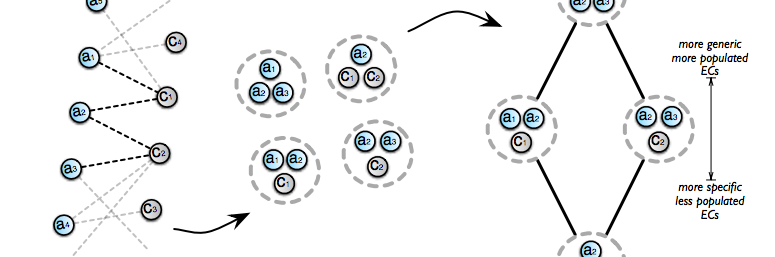
“Socio-technical systems involve agents who create and process knowledge, exchange information and create ties between ideas in a distributed and networked manner: webloggers communities of scientists, software developers and wiki contributors are, among others, examples of such networks. The state-of-the-art in this regard focuses on two main issues which are generally addressed in an independent manner: the description of content dynamics and the study of social network characteristics and evolution. This paper relies on recent endeavors to merge both types of dynamics into co-evolutionary, multi-level modeling frameworks, where social and semantic aspects are being jointly appraised. Case studies featuring socio-semantic graphs, socio-semantic hypergraphs and socio-semantic lattices are notably discussed” (Camille Roth, 2013, image from “Socio-semantic Systems”)
Abstract. Many believe that “big data” will transform business, government and other aspects of the economy. In this article we discuss how new data may impact economic policy and economic research. Large-scale administrative datasets and proprietary private sector data can greatly improve the way we measure, track and describe economic activity. They also can enable novel research designs that allow researchers to trace the consequences of different events or policies. We outline some of the challenges in accessing and making use of these data. We also consider whether the big data predictive modeling tools that have emerged in statistics and computer science may prove useful in economics (Einav and Levin, 2013)


“From the beginning, data was a rhetorical concept. “Data” means that which is given prior to argument. As a consequence, its sense always shifts with argumentative strategy and context—and with the history of both. The rise of modern natural and social science beginning in the eighteenth century created new conditions of argument and new assumptions about facts and evidence. But the pre-existing semantic structure of the term “data” gave it important flexibility in these changing conditions. It is tempting to want to give data an essence, to define what exact kind of fact it is. But this misses important things about why the concept has proven so useful over these past several centuries and why it has emerged as a culturally central category in our own time. When we speak of “data,” we make no assumptions about veracity. It may be that the electronic data we collect and transmit has no relation to truth beyond the reality that it constructs. This fact is essential to our current usage. It was no less so in the early modern period; but in our age of communication, it is this rhetorical aspect of the term that has made it indispensable” (from Rosenberg, Data Before the Fact, 2013)
 cosimoaccoto.com