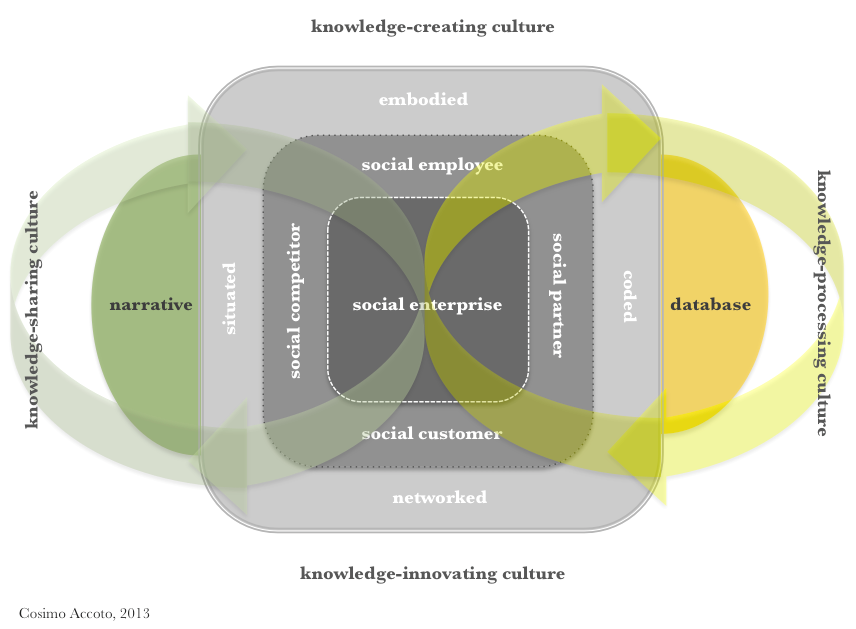
Big science and collaboration (Boisot et alii, 2012, Collision and Collaboration)

Schermata 03-2456355 alle 16.38.55

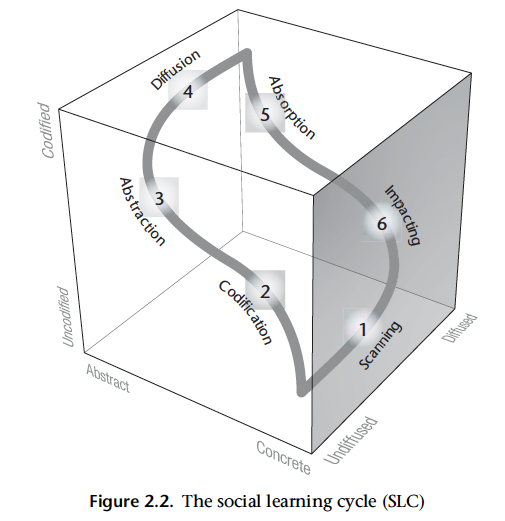
“This cyclical process of knowledge generation, articulation, generalization, dissemination, internalization, and application traces out a “social learning cycle” or SLC. As indicated in Figure 2.2, it consists of six phases, which are further elaborated in Table 2.1. An SLC is an emergent outcome of the data-processing and transmission activities of agents interacting within and across groups of different sizes. To the extent that individual agents can each belong to several groups, each locatable in its own I-Space, they will participate in several SLCs that interact to form eddies and currents. As one aggregates different groups into larger diffusion populations, however, their respective SLCs merge to create a slow flowing river. Figure 2.3 suggests that SLCs come in different shapes and sizes that reflect how extensively a given group invests in its learning processes and in which specific phases of the SLC its investments are concentrated” (Boisot et alii, Collision and Collaboration, 2012)
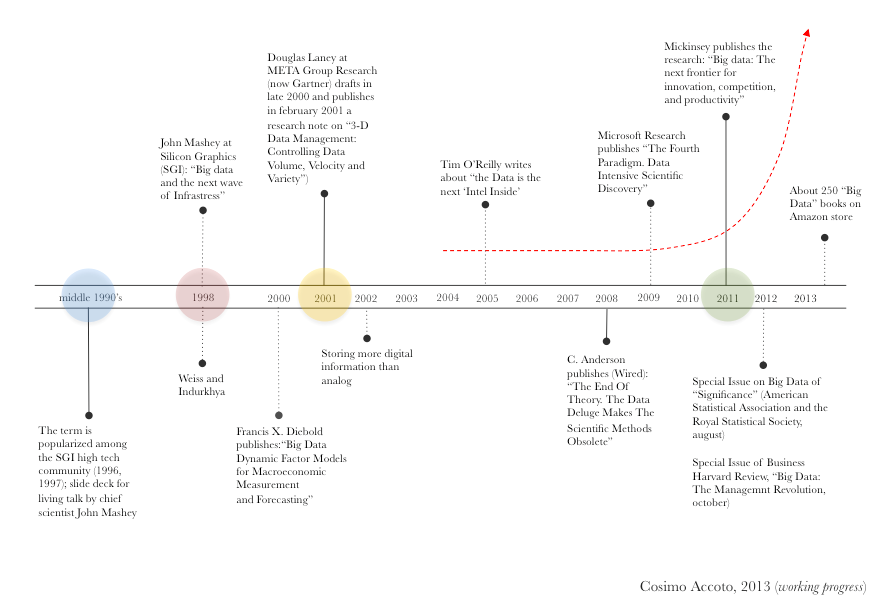
#bigdata concept/info timeline [my working progress]

Schermata 03-2456355 alle 13.27.40

Resources for the timeline:

“The Origins of ‘Big Data’ : An Etymological Detective Story” By Steve Lohr (The New York Times, 2013)

“On the Origin(s) and Development of the Term “Big Data””, Francis X. Diebold (2012) University of Pennsylvania

Google Trend (2013) for the red line (search for “big data”)

Other resourses

Interacting with #Bigdata analytics (2012)

“Increasingly in the 21st century, our daily lives leave behind a detailed digital record: our shifting thoughts and opinions shared on Twitter, our social relationships, our purchasing habits, our information seeking, our photos and videos—even the movements of our bodies and cars. Naturally, for those interested in human behavior, this bounty of personal data is irresistible” (from Fisher et alii, 2012)

http://research.microsoft.com/pubs/163593/inteactions_big_data.pdf

From real-time to subperceptual #bigdata

Note 3

From real-time to subperceptual (and eterogeneity of time in digital age)

“A common trivial statement in big data discourse is claiming business and marketing live nowadays in a “real-time” dimension. I think it’s a misleding sentence because is not enough to say “real-time”. In fact, the concept of “human” real-time has a specific sensorial connotation and limitation and is different from the “machinic” real-time that works in a “sub-perceptual” dimension for humans. It’s time to evolve our big data perspective to include and evaluate the relationship between the computational real-time and the bionic real-time” (Cosimo Accoto, 2013)

From digital "traces" to digital "events" #bigdata

Note 2: From a “trace”  to the “event”

A current trivial discourse correctly underlines the overproduction of “traces” as a by-product of the deployment of digital technologies and networks. If this is a general correct statement, what remains broadly uninvestigated is the ontological and epistemological relation existing between a “trace” and the “event” that generates the trace. We need a more solid investigation (even in term of thermodynamics of a trace as a remnant of an event) about the meaning of a digital trace in the context of a data intensive age (Cosimo Accoto, 2013)

CRM+KM -> CKM: integrating relationship and knowledge management #bigdata

from the abstract:

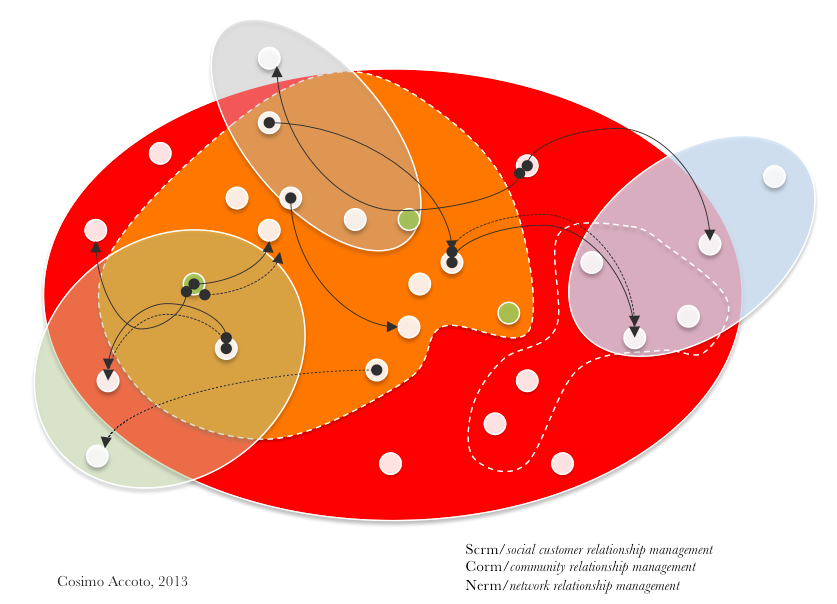
 “Customer Relationship Management (CRM) plays a prominent role in  enabling  businesses  to meet their customers ’  needs, and therefore it acts as a catalyst  in the process of creating and delivering value to them. As CRM concerns managing  customer knowledge, it can be considered as a subset of Knowledge Management  (KM). Therefore, in this study, the effort has been made to propose a Customer Knowledge Management (CKM) process model to compensate the existing lack of a  study integrating CRM and KM with the aim of customer value augmentation. In this CKM model, all forms of CRM are employed to support all the phases of CKM. Finally,  a home appliances case is studied to illustrate the proposed CKM model” (Journal of Journal of Database Marketing  &  Customer Strategy Management (2012)  19, 321 – 347)

http://www.palgrave-journals.com/dbm/journal/v19/n4/pdf/dbm201232a.pdf