New quotes from my forthcoming book #bigdata #beyondbigdata #digitalrealism

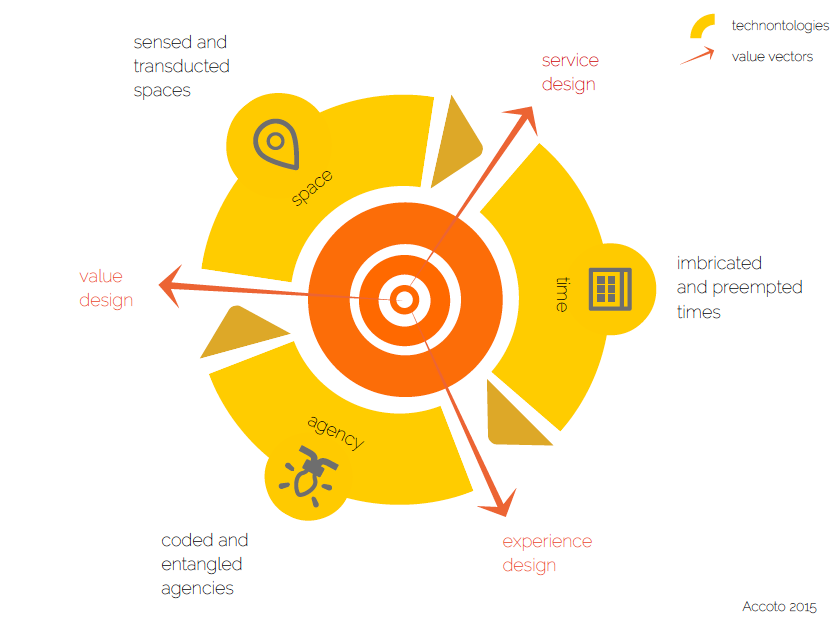
“In digital realism, a data-driven service instantiation is vectorialized by pre/mediation, im/mediacy, sub/mediality”
| Accoto 2014 |

“In digital realism, data agency is ontologically: 1) imbricated 2) entangled 3) coded 4) premediated”
| Accoto 2014 |

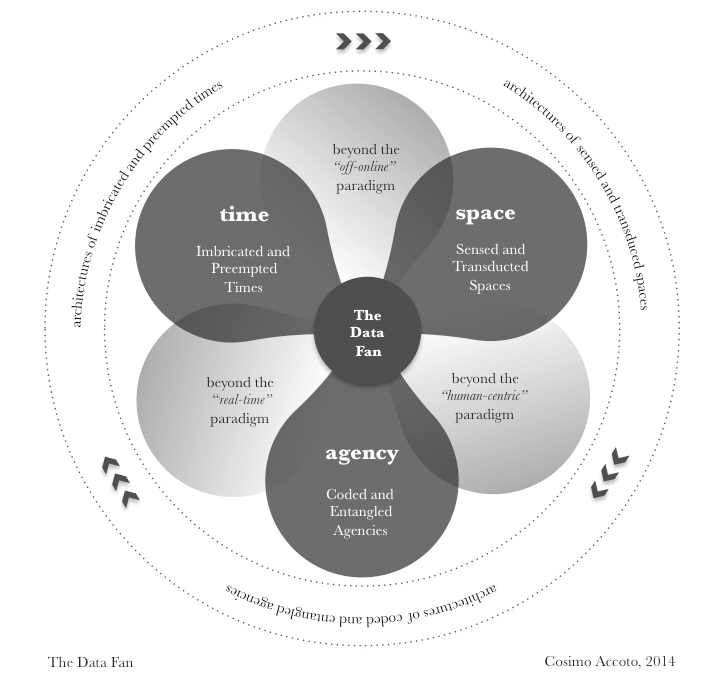
“Big Data is not about 3V’s (and its variants). It’s about space, time and agency: an ontology shift rather than a technology”
| Accoto 2014 |

“In a digital realism perspective, body and code tend to coincide. In the biotic interrupt, the act is indistinguishable from the abstr/act”
| Accoto 2014 |

“Premediative or anticipatory regimes instantiate and operationalize customer data enacting customer horizons”
| Accoto 2014 |

“Quantified Self is not just about lifelogging, but it’s more about lifehacking. Self-hacking is a new self-governing practice”
| Accoto 2014 |

“To be mediated by the immediacy, with N=all (totality) and T=-1 (premediation), is the service instantiation in a data-intensive age”
| Accoto 2014 |

“Quantified selves (Ostherr 2013), social machines (Semmelhack 2013), ambient commons (McCullough 2013) are data actants”
| Accoto 2014 |

“Data Ontologies: Totality, Immediacy, Premediation are the ontological vectors reshaping businesses and organizations”
| Accoto 2014 |

 “In a data deictic perspective, a quantified, networked and anticipated self is emerging as new marketing platform”
| Accoto 2014 |

 “Data deixis changes the logic of the customer segmentation. It’s no longer a logic of set, rather a logic of emergence”
| Accoto 2014 |

“In data-intensive age, customer centricity is useless unless you include the algorithmic mediation of secondary agency”
| Accoto 2014 |

 “The ‘data continuum’ paradigm is reshaping customer information markets and systems as well as industry boundaries”
| Accoto 2014 |

“Looking at data as new personal and partecipatory markets devices is a way to deeply understand our data-intensive age”
| Accoto 2014 |

“In a data-intensive age, “real-time” is an ontological continuum spanning from subperceptuality to embedded temporalities”
| Accoto 2014 |

 “Market, marketing or marke-things intelligence? In an ubiquitous data age, the situated analytics performs operations
| Accoto 2014 |

“Technologies for markets remote sensing are not monitoring practices, but modeling devices for new value propositions”
| Accoto 2014 |

“Big Data is about Transduction of Coded Spaces, Subperceptuality of Emebedded Temporalities and Machinic Secondary Agencies”
| Accoto 2014 |

“In a subperceptual regime of temporality, the im-mediate is ontologically and conceptually linked to the un-mediated”
| Accoto 2014 |

“In digital age, we have performances not contents, performers not users, performables not channels”
| Accoto 2014 |

“In a data-intensive age, customer centricity is useless unless you include the algorithmic mediation of secondary agency”
| Accoto 2014 |

Schermata 04-2456772 alle 19.21.36

A new book “Ask, Measure, Learn” (2014)

A new book on social media analytics covering all the topics related to social media measurement

[…] While there are many different metrics for reach per social media type, none of them are well set to measure awareness by itself. While it is easy to reach many potential consumers with a sufficiently big media budget, it can be hard to make them remember the brand. Direct marketeers often try to build such awareness by employing a so-called trigger that will make the audience react, such as a phone number to call or a question to answer. Those actions will make the audience remember the brand more easily. Social media now offers a bigger range of technical possibilities to trigger a reaction. The Ford example from the introduction to this chapter is already a highly elaborated one. More simple ones can be as easy as just clicking, “like” or “retweet”. With one mouse click, consumers can much more easily react or engage with these channels versus traditional media, and their reactions can be measured. Here are some examples:

▪    How many people clicked something? The biggest example here is click-through rate (CTR), which is well known from web analytics.

▪    How many people redistributed a given article? This could mean that they tweeted, scooped, pinned, liked or shared the article in any other form.

▪    How many people engaged with a given article—replied, discussed, or reacted in any form? How many people copied content or took the main idea from an article? […]

(from Finger and Dutta, “Ask, Measure, Learn”, 2014)

Schermata 04-2456772 alle 11.29.51

Life Out of Sequence. A datadriven history of bioinformatics #bigdata #bigscience

” These differences in appearance and work demonstrate the fundamental changes that have taken place in biology in the last thirty years. Gilbert’s paradigm shift began to change the meaning of the very objects of biology itself. That is, computers have altered our understanding of “life.” In the fi rst place, this change involved the “virtualization” of biological work and biological objects: organisms and genes become codes made up of zeros and ones. But more importantly, information technologies require particular structures and representations of biological objects. These structures and representations have increasingly come to stand in for the objects themselves in biological work. Databases and algorithms determine what sorts of objects exist and the relationships between them. Compared with the 1960s and 1970s, life looks different to biologists in the early twenty-first century. The wet labs and wet work of biology have not disappeared, but they are increasingly dependent on hardware and software in intricate ways. “Seeing” or analyzing a genome, to take one important example, requires automated sequencers, databases, and visualization software. The history recounted in this book is just not a story about how computers or robots have been substituted for human workers, or how information and data have replaced cells and test tubes in the laboratory. These things have occurred, but the changes in biology are far deeper than this. Nor is it just a story about how computers have speeded up or scaled up biology. Computers are implicated in more fundamental changes: changes in what biologists do, in how they work, in what they value, in what experimentation means, in what sort of objects biologists deal with, and in the kind of knowledge biology produces. “Bioinformatics” is used here as a label to describe this increasing entanglement of biology with computers. By interrogating bioinformatic knowledge “in the making,” we learn how biological knowledge is made and used through computers. This story is not about the smoothness of digital fl ows, but about the rigidity of computers, networks, software, and databases” (pag 5-6, from “Life Out of Sequence. A datadriven history of bioinformatics”, Hallam Stevens)

Schermata 02-2456693 alle 22.40.04

Updated quotes from my forthcoming book on “Digital Realism” #bigdata #beyondbigdata

“Big Data is not about 3V’s (and its variants). It’s about space, time and agency: an ontology shift rather than a technology”
| Accoto 2014 |

In a digital realism perspective, body and code tend to coincide. In the biotic interrupt, the act is indistinguishable from the abstr/act”
| Accoto 2014 |

“Premediative or anticipatory regimes instantiate and operationalize customer data enacting customer horizons”
| Accoto 2014 |

“Quantified Self is not just about lifelogging, but it’s more about lifehacking. Self-hacking is a new self-governing practice”
| Accoto 2014 |

“To be mediated by the immediacy, with N=all (totality) and T=-1 (premediation), is the service instantiation in a data-intensive age”
| Accoto 2014 |

“Quantified selves (Ostherr 2013), social machines (Semmelhack 2013), ambient commons (McCullough 2013) are data actants”
| Accoto 2014 |

“Data Ontologies: Totality, Immediacy, Premediation are the ontological vectors reshaping businesses and organizations”
| Accoto 2014 |

 “In a data deictic perspective, a quantified, networked and anticipated self is emerging as new marketing platform”
| Accoto 2014 |

 “Data deixis changes the logic of the customer segmentation. It’s no longer a logic of set, rather a logic of emergence”
| Accoto 2014 |

“In data-intensive age, customer centricity is useless unless you include the algorithmic mediation of secondary agency”
| Accoto 2014 |
 “The ‘data continuum’ paradigm is reshaping customer information markets and systems as well as industry boundaries”
| Accoto 2014 |

“Looking at data as new personal and partecipatory markets devices is a way to deeply understand our data-intensive age”
| Accoto 2014 |

“In a data-intensive age, “real-time” is an ontological continuum spanning from subperceptuality to embedded temporalities”
| Accoto 2014 |

 “Market, marketing or marke-things intelligence? In an ubiquitous data age, the situated analytics performs operations
| Accoto 2014 |

“Technologies for markets remote sensing are not monitoring practices, but modeling devices for new value propositions”
| Accoto 2014 |

“Big Data is about Transduction of Coded Spaces, Subperceptuality of Emebedded Temporalities and Machinic Secondary Agencies”
| Accoto 2014 |

“In a subperceptual regime of temporality, the im-mediate is ontologically and conceptually linked to the un-mediated”
| Accoto 2014 |

“In digital age, we have performances not contents, performers not users, performables not channels”
| Accoto 2014 |

“In a data-intensive age, customer centricity is useless unless you include the algorithmic mediation of secondary agency”
| Accoto 2014 |

Schermata 01-2456669 alle 11.51.03

Introduzione – Verso un nuovo Realismo Digitale (Accoto, 2014)

Introduzione: Verso un nuovo Realismo Digitale

INTRODUZIONE – Verso un Nuovo Realismo Digitale | pdf

“È tempo di muovere le riflessioni tecnologiche e di business contemporanee verso una nuova prospettiva ontologica. Impiegherò, in questo percorso, il termine “nuovo realismo digitale” per indicare questo programma di ricerca. Sono consapevole che storicamente, l’idea di un “realismo digitale” ha avuto un fondamentale e diverso dominio di applicazione. Con realismo digitale si è indicata e si indica, tutt’ora, la capacità dell’arte contemporanea (soprattutto fotografica, videoludica o filmica) di simulare, con perfezione sintetica estrema, il “reale”. In questa tradizione teorica, immagini sintetiche “realistiche” ricercano e ricostruiscono (attraverso le tecnologie digitali) una verosimiglianza, la più prossima possibile, con il loro referente reale (un volto, un corpo, un movimento, un paesaggio, una scena). Chiarisco, qui, che non è questo il realismo cui si fa riferimento. Potremmo, forse, definirlo anche “realismo postdigitale”. Il nuovo realismo digitale di cui parlerò, invece, non descrive un processo di “simulazione”, ma bensì un processo di “attuazione” (Cosimo Accoto, 2014, continua..)

Schermata 12-2456655 alle 16.01.26

Published my short article on #BigData (italian version)

WEBOOK 2013 (cap.4 by Cosimo Accoto)

“A giugno 2013 il termine ‘Big Data’ è stato incluso ufficialmente nell’aggiornamento online trimestrale della Oxford English Dictionary. La definizione descrive il fenomeno come “dati di una dimensione molto grande, in genere nella misura in cui la loro manipolazione e gestione presentano notevoli difficoltà logistiche”. Un anno prima, due delle principali fonti scientifiche e di business avevano dedicato al tema un numero speciale. Nel mese di agosto 2012, Significance (la rivista bi-mensile pubblicata sul conto della Royal Statistical Society e dell’Associazione Americana di Statistica) ha pubblicato un numero dedicato ai Big Data parlando delle dimensioni scientifiche del tema. Due mesi dopo, Harvard Business Review ha pubblicato ‘Big Data: The Management Revolution’ coinvolgendo manager ed esperti per discutere il lato di business e management del fenomeno. L’anno prima ancora (2011), due importanti report avevano acceso il dibattito: un rapporto di 156 pagine di McKinsey che analizzava i Big Data come ‘la prossima frontiera per l’innovazione, la concorrenza e la produttività’ e l’inclusione dei Big Data nell’hypecycle di Gartner per le tecnologie emergenti. Da ultimo, anche il journal accademico Marketing Science ha individuato nei Big Data una top priority emergente nei trend delle ricerche e analisi (vedi figura 1). Eppure, come il filosofo dell’informazione Luciano Floridi ha recentemente detto “non è chiaro che cosa esattamente con il termine big data si intenda”. Ma, cosa sono allora i “Big data”? (continua…Cosimo Accoto, 2013, Big Data tra hype e realtà, Webook 2013, I Quaderni di Comunicazione, from p.34)

Schermata 12-2456637 alle 12.50.18

Building a Digital Analytics Organization (by J. Phillips)

Judah Phillips on “dashboarding”

“Dashboarding is a type of reporting; however, it is different enough from traditional reporting to outline it as its own analytics activity. Although there is no rule of thumb, you may have 100 reports but only one dashboard. Or you may have 10 reports and only one dashboard. The relationship is always that you have fewer dashboards than reports. RASTA-reporting principles can also be applied to dashboards. Dashboarding requires special handling and treatment so that the most relevant, useful KPIs and data are presented in such a way that the data can be explored. The high-level KPIs can be drilled into and explored. The concept of LIVES dashboarding presents an easy-to-remember mnemonic for creating useful dashboards:

• Linked: Dashboards may be delivered in hard copy, but it is more common to view dashboards via a browser or application. Hyperlinking then becomes key to dashboarding because linking can be used to link to other relevant artifacts, such as detail reports and written analysis about the business condition expressed in the dashboard. It is becoming more frequent to see mobile dashboards and even apps for reporting data analysis and dashboarding.

• Interactive: Although it is common to see dashboards that do not enable the exploration of the data within them, the best and most useful dashboards enable drilling down and filtering into the data from the charts and graphs. Often these drilldowns are into detailed data or secondary KPIs.

• Visually driven: Whereas reports are mainly composed of columns and rows of data, dashboards communicate data through charts and graphs. A strong visual narrative using data visualization best practices and clear information design and user experience is always helpful for dashboarding.

• Echeloned: Organize information and data presented in dashboards by relevance and priority to the audience. Put KPIs and other visualizations on your dashboard in the best position for the culture. For example, English speakers look up to the top left on a page, but Hebrew speakers look up and to the right.

• Strategic: Dashboards are not supposed to simply include total counts of this or that metric or data point. Instead, they are supposed to quickly communicate important numbers, KPIs, trends, and data visualizations to the business. These KPIs and data visualizations must be tied to business strategy. The tactics of the business, thus, influence the movement of the data on dashboards. And the movement of data in one direction or another should indicate tactical success or failure to help pinpoint the outcomes of current strategy”

From “Building a Digital Analytics Organization. Create Value by Integrating Analytical Processes, Technology, and People into Business Operations (by Judah Phillips, p.162-163)

Schermata 12-2456628 alle 21.59.17

“Silos Can Threaten #BigData Strategy”

Silos Can Threaten Big Data Strategy

“C-level support is also essential to the success of any big data strategy. Why? Because many brands are still working to develop a consolidated view of their customers, and, all too often, that work becomes a struggle. Then, without strong executive leadership, this struggle can pit departments against one another, and give rise to internal turf wars. Maybe that’s not surprising, considering that customer data is typically collected and owned by a variety of different departments. Marketing collects demographic data; product/customer support keeps customer satisfaction data; finance captures transactional purchase data; and so on. Plus, IT is usually involved in data management and control across multiple departments, which means that IT often also has ultimate ownership over data. In fact, Teradata’s recent research shows that less than one-third of marketers own and control customer data, while more than half rely on IT to access their data. In addition to validating the need for partnership between the CMO and the chief information officer (CIO), these results indicate how crippled data-driven marketing would be in a company that can’t squash turf wars and smash through interdepartmental silos.

I’m a realist, and I understand that turf wars will always exist to some extent. As Hayzlett says, “Wherever you have people and systems, there will be turf wars.” For me, the key is to rise above them. Here’s a tip from Hayzlett’s playbook: “Be clear what business objectives you are trying to drive,” he advises. “Emphasize that you’re there to serve the company, to help the company deliver on the promises you all agreed to make. That is what the focus should be on—what the group is trying to accomplish—not what’s yours or what’s theirs. This approach disarms the turf war, since turf wars break out around personal issues” (from, “Big Data Marketing, Lisa Arthur, 2013)

http://eu.wiley.com/WileyCDA/WileyTitle/productCd-1118733894.html

Schermata 10-2456589 alle 20.42.45

Measuring the health of B2B social communities #communitymetrics #socialdata

[…] Measurement can make the community. By accurately tracking and understanding your community and its trends you can assess the health of the community, determine where it needs to go, and align its success with that of business goals across your company. The metrics that will be available to you may be platform-dependent, but there are common measures that fall into categories such as population, activity, and value. Your business needs will determine the format and frequency in which these are delivered. Your business needs also drive what tools you use to report. If you are delivering periodic reports, Microsoft Excel may suffice. But if you are reporting across multiple platforms, then you may need more sophisticated tools such as mashup reporting tools or an enterprise data warehouse. Likewise, if you are measuring and reporting on lists and counts for your metrics, you can achieve that with spreadsheets and databases. But if you are looking for deep data analysis of the unstructured data in your community forums, you will need specialized tools for collection and processing. As always, being prepared will help ensure success. Setting a baseline and understanding the context of your metrics will support your efforts to explain the results to your executive sponsorship and quantify the value the community health has to other business units. All levels of your company need continual proofs of the proposition that your communities give you unparalleled access to your company’s most valuable asset—your customers (from Brooks, Lovett, Creek, “Developing B2B Social Communities”, 2013:181)

Schermata 10-2456572 alle 19.22.47