Technontologies and Value Vectors (Accoto 2105)

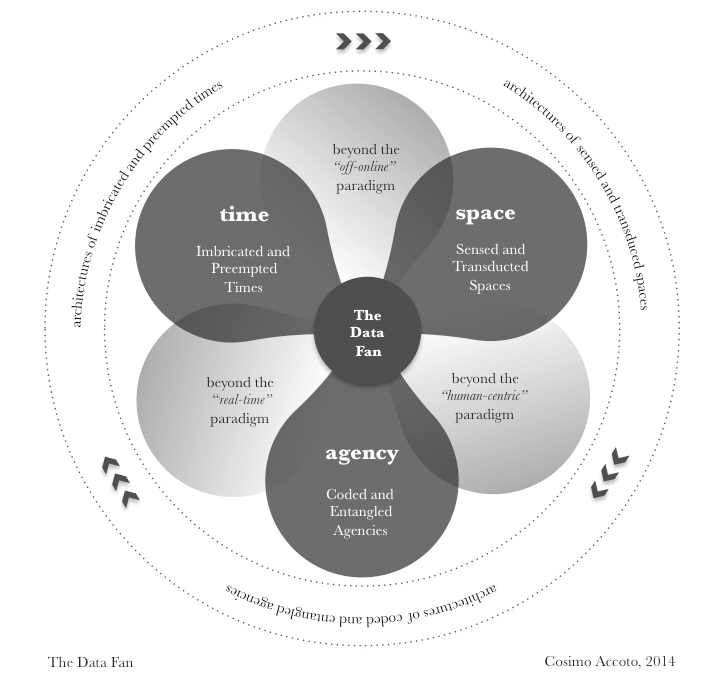
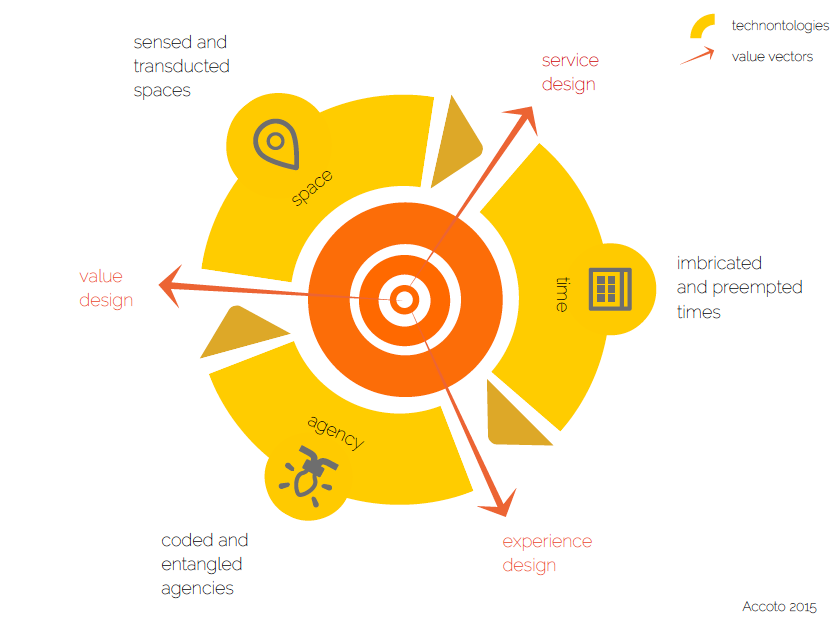
Forget the Big Data 3V’s. Tuning my framework grounded on: 1) time, 2) space and 3) agency. I started to call it “digital realism” to stress the process of digital eversion of the real. I think it’s time to go beyond the current trivial big data and digital transformation discourse and to focus on 3 foundational dimensions: 1) imbricated and preempted time, 2) sensed and transducted space and 3) coded and entangled agency  and to stress 3 business vectors grounded on this technontological architecture: a) value design; b) service design and c) experience design (Accoto 2105)

Schermata 03-2457104 alle 18.48.03

Schermata 03-2457104 alle 18.48.12

Quotes from my forthcoming book #bigdata #beyondbigdata #digitalrealism

“Data is our ultimate world interface”
| Accoto 2014 |

“In digital realism, a data-driven service instantiation is vectorialized by pre/mediation, im/mediacy, sub/mediality”
| Accoto 2014 |

“In digital realism, data agency is ontologically: 1) imbricated 2) entangled 3) coded 4) premediated”
| Accoto 2014 |

“Big Data is not about 3V’s (and its variants). It’s about space, time and agency: an ontology shift rather than a technology”
| Accoto 2014 |

“In a digital realism perspective, body and code tend to coincide. In the biotic interrupt, the act is indistinguishable from the abstr/act”
| Accoto 2014 |

“Premediative or anticipatory regimes instantiate and operationalize customer data enacting customer horizons”
| Accoto 2014 |

“Quantified Self is not just about lifelogging, but it’s more about lifehacking. Self-hacking is a new self-governing practice”
| Accoto 2014 |

“To be mediated by the immediacy, with N=all (totality) and T=-1 (premediation), is the service instantiation in a data-intensive age”
| Accoto 2014 |

“Quantified selves (Ostherr 2013), social machines (Semmelhack 2013), ambient commons (McCullough 2013) are data actants”
| Accoto 2014 |

“Data Ontologies: Totality, Immediacy, Premediation are the ontological vectors reshaping businesses and organizations”
| Accoto 2014 |

 “In a data deictic perspective, a quantified, networked and anticipated self is emerging as new marketing platform”
| Accoto 2014 |

 “Data deixis changes the logic of the customer segmentation. It’s no longer a logic of set, rather a logic of emergence”
| Accoto 2014 |

“In data-intensive age, customer centricity is useless unless you include the algorithmic mediation of secondary agency”
| Accoto 2014 |

 “The ‘data continuum’ paradigm is reshaping customer information markets and systems as well as industry boundaries”
| Accoto 2014 |

“Looking at data as new personal and partecipatory markets devices is a way to deeply understand our data-intensive age”
| Accoto 2014 |

“In a data-intensive age, “real-time” is an ontological continuum spanning from subperceptuality to embedded temporalities”
| Accoto 2014 |

 “Market, marketing or marke-things intelligence? In an ubiquitous data age, the situated analytics performs operations
| Accoto 2014 |

“Technologies for markets remote sensing are not monitoring practices, but modeling devices for new value propositions”
| Accoto 2014 |

“Big Data is about Transduction of Coded Spaces, Subperceptuality of Emebedded Temporalities and Machinic Secondary Agencies”
| Accoto 2014 |

“In a subperceptual regime of temporality, the im-mediate is ontologically and conceptually linked to the un-mediated”
| Accoto 2014 |

“In digital age, we have performances not contents, performers not users, performables not channels”
| Accoto 2014 |

“In a data-intensive age, customer centricity is useless unless you include the algorithmic mediation of secondary agency”
| Accoto 2014 |


Schermata 10-2456951 alle 16.48.08

New quotes from my forthcoming book #bigdata #beyondbigdata #digitalrealism

“In digital realism, a data-driven service instantiation is vectorialized by pre/mediation, im/mediacy, sub/mediality”
| Accoto 2014 |

“In digital realism, data agency is ontologically: 1) imbricated 2) entangled 3) coded 4) premediated”
| Accoto 2014 |

“Big Data is not about 3V’s (and its variants). It’s about space, time and agency: an ontology shift rather than a technology”
| Accoto 2014 |

“In a digital realism perspective, body and code tend to coincide. In the biotic interrupt, the act is indistinguishable from the abstr/act”
| Accoto 2014 |

“Premediative or anticipatory regimes instantiate and operationalize customer data enacting customer horizons”
| Accoto 2014 |

“Quantified Self is not just about lifelogging, but it’s more about lifehacking. Self-hacking is a new self-governing practice”
| Accoto 2014 |

“To be mediated by the immediacy, with N=all (totality) and T=-1 (premediation), is the service instantiation in a data-intensive age”
| Accoto 2014 |

“Quantified selves (Ostherr 2013), social machines (Semmelhack 2013), ambient commons (McCullough 2013) are data actants”
| Accoto 2014 |

“Data Ontologies: Totality, Immediacy, Premediation are the ontological vectors reshaping businesses and organizations”
| Accoto 2014 |

 “In a data deictic perspective, a quantified, networked and anticipated self is emerging as new marketing platform”
| Accoto 2014 |

 “Data deixis changes the logic of the customer segmentation. It’s no longer a logic of set, rather a logic of emergence”
| Accoto 2014 |

“In data-intensive age, customer centricity is useless unless you include the algorithmic mediation of secondary agency”
| Accoto 2014 |
 “The ‘data continuum’ paradigm is reshaping customer information markets and systems as well as industry boundaries”
| Accoto 2014 |

“Looking at data as new personal and partecipatory markets devices is a way to deeply understand our data-intensive age”
| Accoto 2014 |

“In a data-intensive age, “real-time” is an ontological continuum spanning from subperceptuality to embedded temporalities”
| Accoto 2014 |

 “Market, marketing or marke-things intelligence? In an ubiquitous data age, the situated analytics performs operations
| Accoto 2014 |

“Technologies for markets remote sensing are not monitoring practices, but modeling devices for new value propositions”
| Accoto 2014 |

“Big Data is about Transduction of Coded Spaces, Subperceptuality of Emebedded Temporalities and Machinic Secondary Agencies”
| Accoto 2014 |

“In a subperceptual regime of temporality, the im-mediate is ontologically and conceptually linked to the un-mediated”
| Accoto 2014 |

“In digital age, we have performances not contents, performers not users, performables not channels”
| Accoto 2014 |

“In a data-intensive age, customer centricity is useless unless you include the algorithmic mediation of secondary agency”
| Accoto 2014 |

Schermata 04-2456772 alle 19.21.36

A new book “Ask, Measure, Learn” (2014)

A new book on social media analytics covering all the topics related to social media measurement

[…] While there are many different metrics for reach per social media type, none of them are well set to measure awareness by itself. While it is easy to reach many potential consumers with a sufficiently big media budget, it can be hard to make them remember the brand. Direct marketeers often try to build such awareness by employing a so-called trigger that will make the audience react, such as a phone number to call or a question to answer. Those actions will make the audience remember the brand more easily. Social media now offers a bigger range of technical possibilities to trigger a reaction. The Ford example from the introduction to this chapter is already a highly elaborated one. More simple ones can be as easy as just clicking, “like” or “retweet”. With one mouse click, consumers can much more easily react or engage with these channels versus traditional media, and their reactions can be measured. Here are some examples:

▪    How many people clicked something? The biggest example here is click-through rate (CTR), which is well known from web analytics.

▪    How many people redistributed a given article? This could mean that they tweeted, scooped, pinned, liked or shared the article in any other form.

▪    How many people engaged with a given article—replied, discussed, or reacted in any form? How many people copied content or took the main idea from an article? […]

(from Finger and Dutta, “Ask, Measure, Learn”, 2014)

Schermata 04-2456772 alle 11.29.51

Life Out of Sequence. A datadriven history of bioinformatics #bigdata #bigscience

” These differences in appearance and work demonstrate the fundamental changes that have taken place in biology in the last thirty years. Gilbert’s paradigm shift began to change the meaning of the very objects of biology itself. That is, computers have altered our understanding of “life.” In the fi rst place, this change involved the “virtualization” of biological work and biological objects: organisms and genes become codes made up of zeros and ones. But more importantly, information technologies require particular structures and representations of biological objects. These structures and representations have increasingly come to stand in for the objects themselves in biological work. Databases and algorithms determine what sorts of objects exist and the relationships between them. Compared with the 1960s and 1970s, life looks different to biologists in the early twenty-first century. The wet labs and wet work of biology have not disappeared, but they are increasingly dependent on hardware and software in intricate ways. “Seeing” or analyzing a genome, to take one important example, requires automated sequencers, databases, and visualization software. The history recounted in this book is just not a story about how computers or robots have been substituted for human workers, or how information and data have replaced cells and test tubes in the laboratory. These things have occurred, but the changes in biology are far deeper than this. Nor is it just a story about how computers have speeded up or scaled up biology. Computers are implicated in more fundamental changes: changes in what biologists do, in how they work, in what they value, in what experimentation means, in what sort of objects biologists deal with, and in the kind of knowledge biology produces. “Bioinformatics” is used here as a label to describe this increasing entanglement of biology with computers. By interrogating bioinformatic knowledge “in the making,” we learn how biological knowledge is made and used through computers. This story is not about the smoothness of digital fl ows, but about the rigidity of computers, networks, software, and databases” (pag 5-6, from “Life Out of Sequence. A datadriven history of bioinformatics”, Hallam Stevens)

Schermata 02-2456693 alle 22.40.04

Updated quotes from my forthcoming book on “Digital Realism” #bigdata #beyondbigdata

“Big Data is not about 3V’s (and its variants). It’s about space, time and agency: an ontology shift rather than a technology”
| Accoto 2014 |

In a digital realism perspective, body and code tend to coincide. In the biotic interrupt, the act is indistinguishable from the abstr/act”
| Accoto 2014 |

“Premediative or anticipatory regimes instantiate and operationalize customer data enacting customer horizons”
| Accoto 2014 |

“Quantified Self is not just about lifelogging, but it’s more about lifehacking. Self-hacking is a new self-governing practice”
| Accoto 2014 |

“To be mediated by the immediacy, with N=all (totality) and T=-1 (premediation), is the service instantiation in a data-intensive age”
| Accoto 2014 |

“Quantified selves (Ostherr 2013), social machines (Semmelhack 2013), ambient commons (McCullough 2013) are data actants”
| Accoto 2014 |

“Data Ontologies: Totality, Immediacy, Premediation are the ontological vectors reshaping businesses and organizations”
| Accoto 2014 |

 “In a data deictic perspective, a quantified, networked and anticipated self is emerging as new marketing platform”
| Accoto 2014 |

 “Data deixis changes the logic of the customer segmentation. It’s no longer a logic of set, rather a logic of emergence”
| Accoto 2014 |

“In data-intensive age, customer centricity is useless unless you include the algorithmic mediation of secondary agency”
| Accoto 2014 |

 “The ‘data continuum’ paradigm is reshaping customer information markets and systems as well as industry boundaries”
| Accoto 2014 |

“Looking at data as new personal and partecipatory markets devices is a way to deeply understand our data-intensive age”
| Accoto 2014 |

“In a data-intensive age, “real-time” is an ontological continuum spanning from subperceptuality to embedded temporalities”
| Accoto 2014 |

 “Market, marketing or marke-things intelligence? In an ubiquitous data age, the situated analytics performs operations
| Accoto 2014 |

“Technologies for markets remote sensing are not monitoring practices, but modeling devices for new value propositions”
| Accoto 2014 |

“Big Data is about Transduction of Coded Spaces, Subperceptuality of Emebedded Temporalities and Machinic Secondary Agencies”
| Accoto 2014 |

“In a subperceptual regime of temporality, the im-mediate is ontologically and conceptually linked to the un-mediated”
| Accoto 2014 |

“In digital age, we have performances not contents, performers not users, performables not channels”
| Accoto 2014 |

“In a data-intensive age, customer centricity is useless unless you include the algorithmic mediation of secondary agency”
| Accoto 2014 |

Schermata 01-2456669 alle 11.51.03