“The data directive is an Economist Intelligence Unit (EIU) report, commissioned by Wipro. It seeks to explore the degree to which the ongoing data revolution within business is delivering truly strategic change within companies, as opposed to more incremental optimisation gains. Although many of the issues discussed here stray into the realm of so-called “big data”, this report is not explicitly focussed on that topic and does not deal with any technology-related issues. Instead, it seeks to explore how the wider trend toward a greater reliance on data is affecting the strategic management of businesses at a C-suite level, across a range of industries” (The Economist – Intelligence Unit, April 2013)
Author: Cosimo Accoto
Big Data Analytics (by Arvind Sathi, 2013)
“So, what is Big Data? There are two common sources of data grouped under the banner of Big Data. First, we have a fair amount of data within the corporation that, thanks to automation and access, is increasingly shared. This includes emails, mainframe logs, blogs, Adobe PDF documents, business process events, and any other structured, unstructured, or semi-structured data available inside the organization. Second, we are seeing a lot more data outside the organization some available publicly free of cost, some based on paid subscription, and the rest available selectively for specific business partners or customers. This includes information available on social media sites, product literature freely distributed by competitors, corporate customers’ organization hierarchies, helpful hints available from third parties, and customer complaints posted on regulatory sites” (from “Big Data Analytics”, Arvind Sathi, 2013)
Social Networks and Socio-semantic Systems (Roth, 2013)
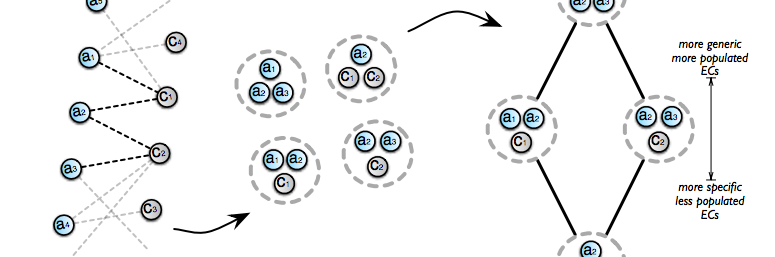
“Socio-technical systems involve agents who create and process knowledge, exchange information and create ties between ideas in a distributed and networked manner: webloggers communities of scientists, software developers and wiki contributors are, among others, examples of such networks. The state-of-the-art in this regard focuses on two main issues which are generally addressed in an independent manner: the description of content dynamics and the study of social network characteristics and evolution. This paper relies on recent endeavors to merge both types of dynamics into co-evolutionary, multi-level modeling frameworks, where social and semantic aspects are being jointly appraised. Case studies featuring socio-semantic graphs, socio-semantic hypergraphs and socio-semantic lattices are notably discussed” (Camille Roth, 2013, image from “Socio-semantic Systems”)
The Data Revolution and Economic Analysis (Einav & Levin, 2013)
Abstract. Many believe that “big data” will transform business, government and other aspects of the economy. In this article we discuss how new data may impact economic policy and economic research. Large-scale administrative datasets and proprietary private sector data can greatly improve the way we measure, track and describe economic activity. They also can enable novel research designs that allow researchers to trace the consequences of different events or policies. We outline some of the challenges in accessing and making use of these data. We also consider whether the big data predictive modeling tools that have emerged in statistics and computer science may prove useful in economics (Einav and Levin, 2013)
data before the fact (rosenberg, 2013)
“From the beginning, data was a rhetorical concept. “Data” means that which is given prior to argument. As a consequence, its sense always shifts with argumentative strategy and context—and with the history of both. The rise of modern natural and social science beginning in the eighteenth century created new conditions of argument and new assumptions about facts and evidence. But the pre-existing semantic structure of the term “data” gave it important flexibility in these changing conditions. It is tempting to want to give data an essence, to define what exact kind of fact it is. But this misses important things about why the concept has proven so useful over these past several centuries and why it has emerged as a culturally central category in our own time. When we speak of “data,” we make no assumptions about veracity. It may be that the electronic data we collect and transmit has no relation to truth beyond the reality that it constructs. This fact is essential to our current usage. It was no less so in the early modern period; but in our age of communication, it is this rhetorical aspect of the term that has made it indispensable” (from Rosenberg, Data Before the Fact, 2013)
In search of insight and foresight (Economist, 2013)
“How can you get there if you don’t know the route? This may seem an odd question, but a tremendous number of organisations working hard to leverage data to their advantage have no real roadmap. To create one, companies must first use data to understand past performance and where their journey has taken them so far. Then, they can see where they are headed—or could go if they pointed themselves in the optimal direction. Behind every effort to effectively leverage data for insight into a business, and foresight into a path to strong performance, is a process involving smart hypotheses and savvy questions whose answers show the way” (from the executive summary, The Economist, Intelligence Unit paper, 2013)
#BigData: major shifts of mindset

“[…] big data is about three major shifts of mindset that are interlinked and hence reinforce one another. The first is the ability to analyze vast amounts of data about a topic rather than be forced to settle for smaller sets. The second is a willingness to embrace data’s real-world messiness rather than privilege exactitude. The third is a growing respect for correlations rather than a continuing quest for elusive causality” (“Big Data”, 2013, Mayer-Schonberger and Cukier)
#BigData and Governance (Maude Bonenfant, Marc Ménard, André Mondoux and Maxime Ouellet)
[from the abstract] “For several years now, the media, the business world, and information technology (IT) have often used “Big Data” to describe a new society-wide dynamic. It is characterized not only by the production of massive amounts of data, but also— and especially—by the huge potential benefits that new statistical data-analysis tools would confer. The proliferation of data is so extensive that data capture and
analysis are increasingly presented as exceeding human reach, thus necessitating the use of tools and IT methods for interpretation. Data extraction and analysis are defined as “data mining,” without presenting data production, access, and analysis as socially constructed (e.g., with ideological, political, economic dimensions). Instead, they constitute a means for deriving “natural” information (the Real). In this light, Big Data may be seen as a technique that dispenses with symbolic mediation and thus lies outside the field of politico-ideological debate. Our presentation deals with the potential consequences of models based on Big Data” (“Big Data and Governance”,)
Interrupt, dataspace and the sensorium of the world #bigdata
Big Data is emerging from the interrupt process because finally the dataspace of software is connected to the sensorium of the world. Have a lot to this entry 😉
“The interrupt fundamentally changed the nature of computer operation, and therefore also the nature of the software that runs on it. The interrupt not only creates a break in the temporal step- by- step processing of an algorithm, but also creates an opening in its “operational space.” It breaks the solipsism of the computer as a Turing Machine, enabling the outside world to “touch” and engage with an algorithm. The interrupt acknowledges that software is not sufficient unto itself, but must include actions outside of its coded instructions. In a very basic sense, it makes software “social,” making its performance dependent upon associations with “others”—processes and performances elsewhere. These may be human users, other pieces of software, or numerous forms of phenomena traced by physical sensors such as weather monitors and security alarms. The interrupt connects the dataspace of software to the sensorium of the world” (Interrupt, Yull, in Software Studies: A Lexicon, The MIT Press).